Monday, July 3, 2017

Camino Day 3


I'm determined to get this finished in the next day or two!  So, back to the Camino of Santiago - our adventure continued on Day 3!

We are learning, slowly, that we need to get an earlier start - and an earlier finish.  That seems to be the routine on the Camino.  We awake, had a nice breakfast, celebrated Mass and goofed off a bit!  Dan Carr found a good window from which to offer a "Pontificial Blessing" to all of us pilgrims below...

Anyway, we got back on the road and arrived first at the town of Leboreiro.  There is the church of Santa Maria de Leboreiro.  A very beautiful statue of San Diego (St. James) the pilgrim.  


After passing through the town of Furelos we crossed a Medieval bridge and came into Melide.


 I just thought the Calla Lilies were beautiful in bloom!


Melide has a fascinating history.  Is is the place where the two Casinos meet: the Camino Primitive (Original Way) ends here in Melide - while the Camino Frances (French Way) passes through the town on its way toward Compostela.  The story is that Melide didn't begin to grow until after the discover of the tomb of St. James - so from the 10th Center on Melide was important as pilgrims passed through the town - leading to many traders and innkeepers setting up shop to care for them.

In the early 14th Century, as the Archbishop of Santiago (Berenguel de Landoria) was on his way to Santiago to take possession of the Diocese, he stayed here in Melide.  To thank the townspeople for their hospitality he gave them permission to build a fortress and charge taxes - a fortress which was destroyed only 100 years later.

The town is a regular city - and provides pilgrims with a real present stop on the way.  And stop we did!  We had learned from other days not to put off lunch for the next town - because you sometimes never know what the next town will hold.  So, entering Melide, we found a place along the road to get some lunch - even though it was on 11:30 and we had not been on the road for that long.

We headed through the town - not without some confusion - as the Camino signs are now in the middle of the street... we hadn't seen that in a while.


We got back into the wilderness and found the donkey stamp.  Don't ask me...


But immediately after was an old stone bridge over the stream.  


And again, the beautiful countryside.


We continued on to Boente.  We found a church in the town: St. James (of course) in the Diocese of Lugo (the stamp tells me this).  


This doesn't seem like much - but after all the kilometers on aching feet at a rapid pace... this hill was KILLER!


So we stopped at the top at Bar No Camino go get something to drink.  Boy did that beer taste GOOD!  We continue on and arrive in Casteneda - a town which was famous for the furnaces where lime was prepared for use during the construction of the Cathedral in Santiago.  So it's got quite a connection to the Apostle and the Cathedral.

Everywhere along the way we kept seeing these...


WE did not know what they were and each a a turn at speculating.  I thought they were perhaps for drying produce or something - as they all had slats or holes and a small door.  (Turns out, in Santiago we asked a vender who had pictures of them - they are for storing corn).

As we drew close to Ribadixo, we crossed the Rio Iso - a very calm and refreshing spot.


But there was no time to waste!  Our goal was getting within sight - Santiago by Thursday!  So he pushed on into the town of Arzura - it is the last big town before Santiago.  It's a modern town - and you can tell that as you enter into it.  Because of our previous experience with Alburgue, we had booked an AirBNB here in Arzua.  We had a GPS on our phone and looked for the address.  I at this point was PAST the point of being tired... I was slow and hurting.


Fortunately we had arrived MUCH earlier than previous days - about 5:30pm.  Nonetheless, it seemed a long walk through the town until we finally got to our AirBNB and met our host, who took us to our apartment for the night -- 4th floor!  YIKES!  These tired feet - those packs... 4 flights!  OUCH!  But we all did it - collapsed in the dining room and opened up a cold drink.  This was a nice apartment that we had all to ourselves - four separate rooms, kitchen, dining room and bath (of course).  We were TOO TIRED to go out for dinner, so we simps went to the local grocery store and bought stuff for fajitas (Old El Paso).  We bought ground chicken and beef pork - at least that's what it said...  it was REALLY pink - and when we cooked it, it didn't change color (so Stephen and I just added the El Paso flavoring so no one would notice the odd color - better the others now know).  We also got some chips, salsa and lemonade beer - oh, and ice cream!  Had a pleasant evening here where we recharged for Day 4.

Sunday, July 2, 2017

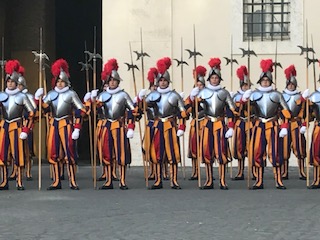
Swearing in of the Swiss Guard - May 6 - including video

Back on May 6 I was privileged to attend the annual swearing in of the new members of the Swiss Guard.  It is an event that he held every May 6 in commemoration of a very important event... the Sack of Rome in 1527.


Here is information directly from the Vatican's website...


May 6th: The Recruits Take their Oath of Loyalty

There is a date in the history of the Swiss Guard in the Vatican, that is closely linked with the history of the Church herself, because it was a day marked by the blood of 147 of her sons: May 6th, 1527, the Sack of Rome. This date, which in 1527 was a day of death, today, is a day of life, because each year on this day, the new recruits take their solemn oath of loyalty. It is a most moving ceremony which takes place in the historic St. Damaso Courtyard within the Vatican City, in the presence of religious personalities, political and military representatives of the Swiss Confederation and many relatives, friends and admirers of the Guard. The Guard, from the Commandant down to the newest Halberdier, is in full dress-uniform, a marvelous sight. The band with its superb drummers is warmly applauded. The Chaplain gives a solemn reading of the oath:


"I swear I will faithfully, loyally and honourably serve the Supreme Pontiff Francis and his legitimate successors, and also dedicate myself to them with all my strength, sacrificing if necessary also my life to defend them. I assume this same commitment with regard to the Sacred College of Cardinals whenever the See is vacant.

Furthermore I promise to the Commanding Captain and my other superiors, respect, fidelity and obedience. This I swear! May God and our Holy Patrons assist me!"


Then one by one the new recruits are called by name. Each one advances alone, and with his left hand he grasps the Guarďs standard, holding high his right hand with three fingers open, as a symbol of the Trinity, Father, Son and Holy Spirit, and he confirms the oath:


"I, . . ., swear I will observe faithfully, loyally and honourably all that has now been read out to me! May God and his saints assist me!" 


 These saints included especially the Guard's Patrons, St. Martin (November 11th), St. Sebastian (January 20th), and St. Niklaus von Flüe, "Defensor Pacis et pater patriae" (September 25th).

Then the band leads the group out of the courtyard... 


Investiture in Zagreb, Croatia & Blessed Cardinal Stepinac


WAY back on May 12-13, Cardinal O'Brien and I traveled to Zagreb, Croatia for the 1st investiture in Croatia - although the Order has a much older history and connection to the Holy Land.

Because of flight connections, we didn't arrive in Zagreb until rather late on Friday evening - so we had a bite to eat and went right to bed - as the Investiture was first thing in the morning.  As the Mass began, Josip Cardinal Bozanić offered a greeting.  


Then the Investitures began...


I like this photo - the Cardinal waving to all the members gathered outside...


Buried in the Cathedral in Zagreb is the body of Blessed Aloysius Cardinal Stepinac - who was the Cardinal Archbishop from 1937 until his death in 1960 - as a martyr under the Communist Regime.  His story is below - in all its controversy...


He’s seen by Croatians as a national hero, but derided as a Nazi sympathizer, or worse, by his critics, prominently including many Serbs, who charge Stepinac was complicit in anti-Serb brutalities in the wartime independent state of Croatia.
That’s clearly not a view shared by recent popes.  St. John Paul II described Stepinac as a man who “had the strength to oppose the three great evils of his century: Fascism, Nazism, and Communism,” during a 1998 beatification Mass.
As the youngest bishop in the world at the time, Stepinac became the coadjutor Archbishop of Zagreb in 1934.  Just a few years later, the Second World War loomed over Europe and Stepinac was forced to navigate the turmoil.  The record shows that he did so without aligning himself with any political party or movement, although many today unreasonably associated him with the Ustaša, a nationalist faction that arose in Croatia before and during World War II.   Of course, similar accusations are also directed at Pope Pius XII, the wartime pontiff, for not “doing enough“ to condemn Nazism and fascism.
Benedict XVI obviously doesn’t buy that criticism either.  During his own trip to Croatia in 2011, Benedict emphasized that “Stepinac knew how to resist every form of totalitarianism, becoming … a defender of the Jews, the Orthodox and of all the persecuted, and then, in the age of Communism, an advocate for his own faithful, especially for the many persecuted and murdered priests.”
According to the postulator for Stepanic’s sainthood cause, Monsignor Juraj Batelja, there are 40,000 pages of material ready to be revealed after the canonization.  Each page contains testimonials from Stepinac’s contemporaries, including people who were poor, prosecuted and threatened, and whose lives were rescued thanks to Stepinac’s intervention.
Stepinac was a ‘persona non grata’ in the years of the Ustaša regime (1941-1945) and also a thorn in Yugoslavia’s side (1945-1991), whose leadership under Josip Broz Tito wanted a ‘national Church,’ independent of the Holy See.  Tito’s Communist regime arrested Stepinac on September 18, 1946, and hauled him before a politically-staged show trial. Based on extorted statements and false testimonies, Stepinac was sentenced to 16 years in prison and forced labor, and a further five years of deprivation of all civil rights.
It’s no secret that while Stepinac was serving his sentence in Lepoglava prison (1946-1951), he was systematically poisoned with the toxic substances of cadmium, chrome, lead and arsenic.   According to even the Vatican prosecutor in the cause, whose job is to try to knock down the argument for sainthood, “Stepinac’s virtues shine like the sun.” Moreover, there’s already a miracle lined up for canonization, approved by both the Vatican’s medical commission and the congregation’s theological consultors.
Despite all that, Pope Francis has decided to proceed with caution.  Recently, the pope initiated the establishment of a joint working group between the Catholic Church and the Serbian Orthodox Church to air concerns about Stepinac’s life and record, in order to eliminate all doubt on the Orthodox side about his worthiness.
To be honest, the vast majority of the Croatian public was not enthusiastic about the pope’s decision. They’re well aware of the fierce propaganda campaign against Stepinac that’s been waged by representatives of the Serbian Orthodox Church, Serbian politicians, Serbian diplomacy and the Serbian media.  For example, shortly after the Pope's decision, two Orthodox churches in Manhattan and Sydney and an Orthodox monastery were burned.  On May 4, the New York Post quoted Orthodox who “believe the blazes … may have been set in retaliation for Pope Francis’ recent decision to postpone the canonization of Croatian Cardinal Aloysius Stepinac, an infamous Nazi supporter.”
The current Archbishop of Zagreb, Cardinal Josip Bozanić, defused the situation by saying that the pope’s decision is to be viewed as an ecumenical gesture, and a step toward the periphery – in this case, a spiritual periphery where the Church is open to discussion with everyone.
So, you can see - his cause is not an easy one and bring with it a lot of emotion on both sides of the issue.  
Anyway, following the Mass was the traditional banquet where, as usual Cardinal O'Brien went table to table for photos.


The Cathedral in Zagreb - Governor General Agostino Borromeo  is seen on the right.


That evening there was a gala reception and exhibition discussing and describing the connection between Zagreb, Croatia and the Holy land.  


Sunday morning we had a small private Mass at the Franciscan Monastery before heading to the plane for the return trip to Rome.


Feast of St. Justin


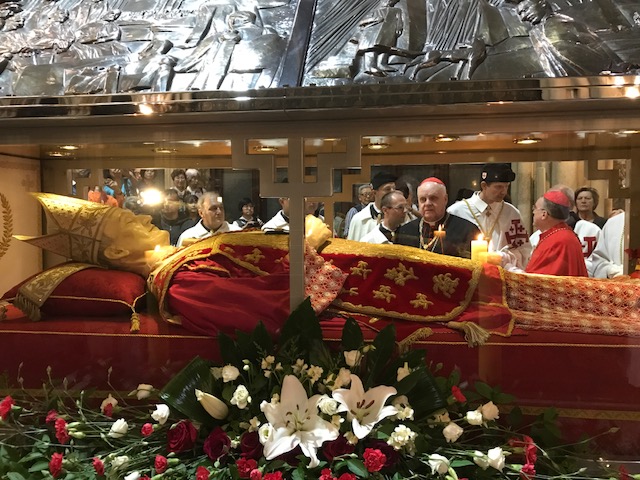
I've been trying, as much as possible, to go to the tomb of the saints on their Feast day.  So, on June 1 - the Feast of St. Justin - I went to the church of St. Lawrence Outside the Walls.  Here, beneath the altar in an accessible crypt under the chancel, is located the tomb of St. Lawrence.  Relics of St. Stephen and St. Justin Martyr are also enshrined here.  An altar has been built on the west side of the tomb, which is surrounded by a grate. 


Near the tomb, below the steps leading up to the chancel, is a room housing some 6th-century ruins that were excavated in 1947-49. These include part of the apse and the Shrine of the Unknown Martyr, which early pilgrims visited after the tomb of St. Lawrence. In the 9th century it was expanded into an underground chapel with an apse. The shrine is decorated with frescoes that probably date from the time of Pope John VII (705-07), depicting Maria Regina surrounded by saints holding up crowns. More frescoes were added in the 9th century, depicting the Virgin and Child Enthroned accompanied by angels, St. Lawrence, St. Andrew, St. John the Evangelist, and St. Catherine. 


 The side aisles of the basilica have been uncovered down to original floor level (2.15m lower than the nave) and can be entered via stairs at the front of the nave aisles. The 6th-century aisles provide access to the inner narthex of the same date, which now houses the Chapel of Pope Pius IX and is decorated with 19th-century mosaics. The pope's preserved body is on display against the east wall. On the opposite wall, against the structure housing the tomb of St. Lawrence, is the "Stone of St. Lawrence," a marble slab with a large stain. According to tradition, Lawrence's body was laid on this stone after his execution, staining it with blood.


Investiture in Salzburg, Austria

Continuing my "backward chronology" approach to blogging in these days, I go back to June 15-18, when Cardinal O'Brien and I traveled to Salzburg, Austria for an investiture.  It was only to be the normal Friday-Sunday trip but - as often happens here in Rome - there was the threat of a BIG strike which would affect air travel.  Rather than get stranded and not arrive in time for the Mass on Saturday, we decided to change our flight and leave on Thursday, rather than Friday.  That would be sure to get us into Salzburg in time (as the strike was only for Friday).

So we left a day early - only to be delayed leaving Rome - and missing our connecting flight (only by 5 minutes) in Vienna.  Rather than wait 5 hours for the next flight, we opted for the train from Vienna to Salzburg.  It really was a pretty ride - I'm sorry I didn't take any photos...  But we did finally arrive (3 hours later than planned) and we went right to the Hotel Sacher and had a lovely dinner with the Lieutenants of Switzerland and Austria (who were holding a joint investiture).

But this early arrival meant that we had one day completely free in Salzburg.  I hadn't been here since my high school German Class trip in... oh my, 1982 (?) - so I wanted to walk around a bit on my own and just explore.

We had Mass in the morning at the Franciscan monastery in old Salzburg (walking past Mozart's birth house).  Then we had the day to ourselves, so I stopped for a quick lunch and headed to the Archbishop's Palace WAY up on the hill.  You have to take an incline to get there...


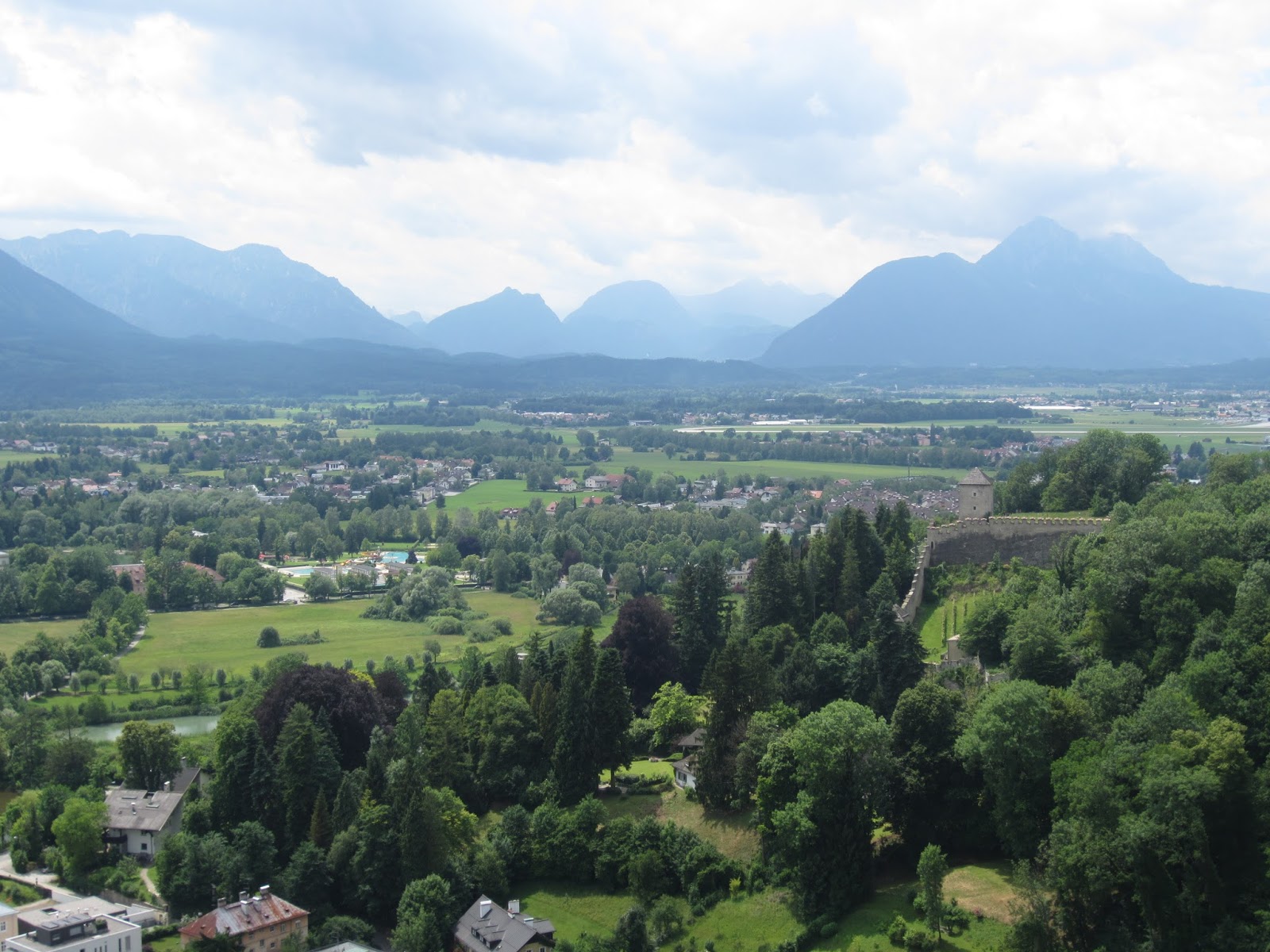
But it gives a BEAUTIFUL view of the city... the mountains... the hills... are alive, with the Sound of Music... - sorry, I couldn't help it :-)


Inside the palace is what they call the "Bull" - a carillon 


They gave a tour of the palace


And the beautifully decorated Archbishop's private rooms - bedroom and living room / study

The furnace


The kitchen


Salzburg Cathedral


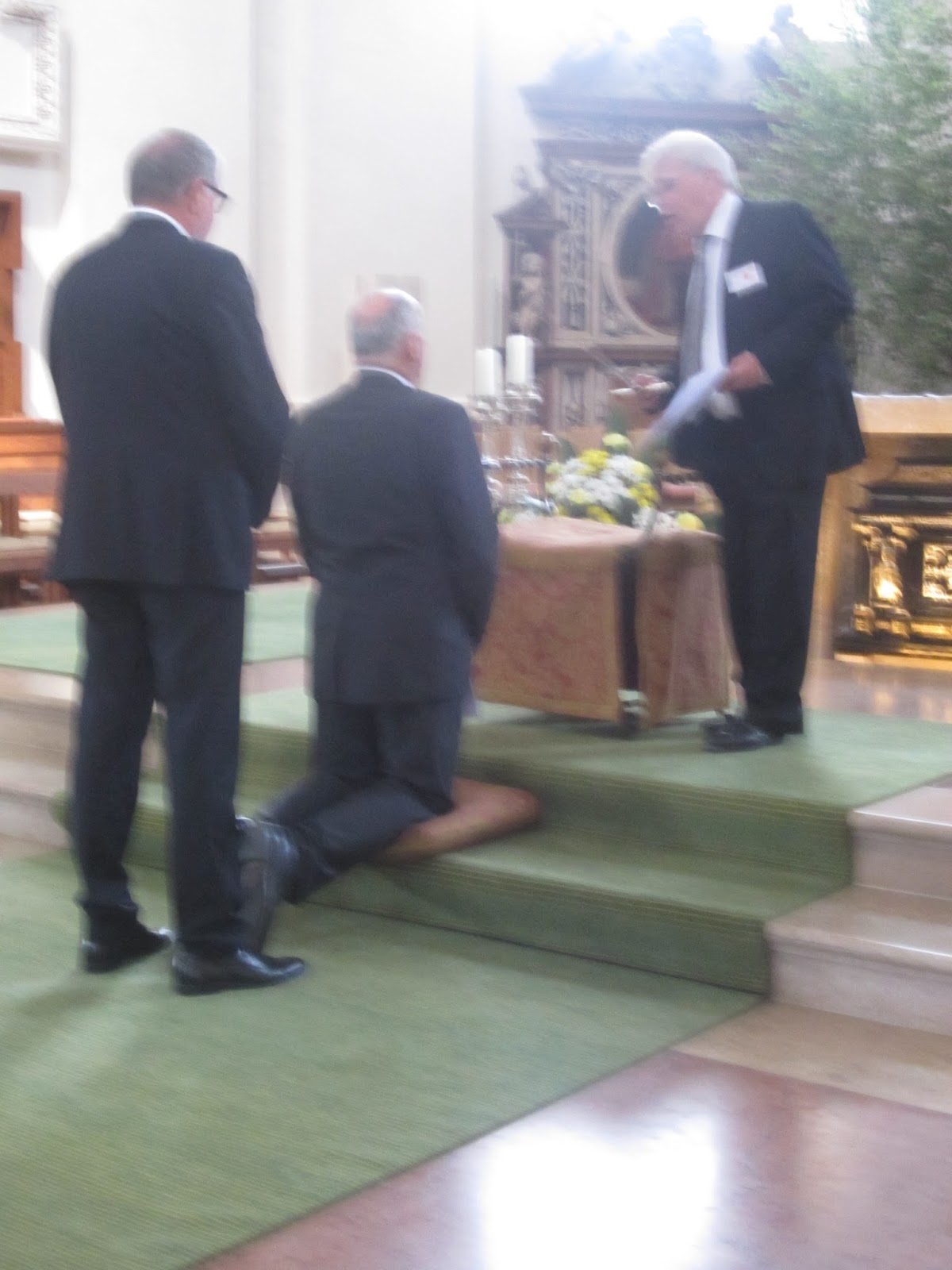
And practice for the Investiture


The Investiture ceremonies began with a chance for all the candidates to introduce themselves to all the Knights and Dames assembled - and a little concert...


 ... with a Swiss Alpine Horn


And the Procession into the Church begins the Investiture Mass on Saturday morning.


This is the only Investiture where the Swiss Guard are present - because Switzerland was involved in the Investiture - they have that privilege of having members of the Swiss Guard present, in uniform, outside of Rome.


Of course the music for the Mass was Mozart - how could it be anything else?


The Cardinal, Bishops, priests, Lieutenants and new members gathered for a photo


Then the celebratory Banquet...  The Cardinal ALWAYS goes around to tables so people can have photos with him.


Even I got to be in one of the photos... 

Me, the Lieutenant from Switzerland and his wife, Cardinal O'Brien, the Chancellor and Lieutenant from Austria