Thursday, March 23, 2017

Thursday - 3rd week of Lent - Sts. Cosmas and Damian

From PNAC.org 

Sitting discreetly to the side of the Roman Forum, the small basilica of Ss. Cosmas and Damian can boast of not only a longer history of use than that ancient center of government, but also of that use continuing to the present day.  In fact, parts of this basilica date back to the time of the ancient forum, these structures being converted into a church in honor of these two saints some time later.  Ss. Cosmas and Damian were two brothers in the medical profession, who used their skills to heal people without seeking payment.  Although there are different traditions concerning their martyrdom, it seems likely that they suffered during the Diocletian persecutions in the early fourth century in the city of Aegea, then in Roman Syria.  Brought before the tribunal, they were tortured before being killed by decapitation, likely in 303.  Some years later their relics were brought to the city of Cyr, before being brought to Rome during the time of Pope St. Gregory the Great.
Some of the walls of the current structure can be traced as far back as the Emperor Vespasian, who reigned from A.D. 69 to 79.  Some time later a secular basilica was built on the site, which had a similar shape but a different purpose than later ones built for religious purposes.  Pope Felix IV modified the structure to include an adjacent circular temple, built at a later date than the secular basilica had been, for use as a house of worship and dedicated it around the year 530.  The beautiful mosaics that survive until the present are from this time, with some restorations, and would in turn inspire many others in the city.  The interior was refurbished about 150 years later, and in the late eighth century it was restored for use as a deaconry by Pope Adrian I.  The basilica continued without any significant changes until the baroque period.  At that time, spurred on by the rediscovery of the relics of the brother saints in 1582, Pope Clement VIII added side chapels to the nave in 1602.  This was followed by a more significant renovation under Urban VIII which saw a new floor installed at the actual ground level.  This had the effect of cutting off the lower half of the church from sight, as well as allowing for a closer viewing of the apse mosaic.  The general interior arrangement remained unchanged until the late twentieth century, when the floor of the circular part of the church was removed.

Today, the church is entered from behind, as the excavation of the forum has left the 17th century entrance unusable.  Passing through the beautiful cloister you see a wonderful foundation.  The entrance to the lower church is there, which takes you down to the tomb of Sts. Cosmas and Damian - and the ancient, ancient church underneath the present one.


Where Sts. Cosmas and Damian are buried - inside the altar


Tuesday, March 21, 2017

Tuesday - 3rd Week of Lent - San Prudenziana

From PNAC.org and Procedamus in Pace.
The little church of St. Pudentiana holds some of the earliest memories of the Roman Church within its ancient walls.  The Christian history of this site begins with St. Pudens, a Roman senator.  He allowed St. Peter to live in his house for at least six years, and it is believed that the first Mass celebrated by St. Peter in Rome took place here.  He may also be the Pudens named by St. Paul in one of his letters (2 Tm. 4:21).  An early tradition also held that he had two daughters, Pudentiana and Praxedes.  These two collected the remains of the martyrs after their death, laying many of them to rest in a well within their home.  Another early member of the Roman Church, St. Pastor, is thought to have set up an oratory on this site as well.


Any buildings on this site were either demolished or heavily modified to make way for the construction of a bath hall here in A.D. 139.  This structure would have had a large inner hall completely surrounded by an ambulatory.  At some later point this building came to be used for Christian worship, with the earliest proof of this dating from 384.  At this time the church was known as the Titulus Pudentis, after the traditional patron of Christian worship on the site.  A renovation followed, likely in the last decade of the fourth century, which demolished one end of the building and lengthened it.  The opposite end was renovated as a sanctuary, being decorated with a mosaic that comes down to us today.  Around the year 535, another renovation took place, mainly concerned with strengthening the walls.  The church was restored in the late eighth century and again at the turn of the twelfth century.  Around the time of this latter date the campanile was built.  The interior reached its current state between 1588 and 1599, when a renovation in a restrained baroque style took place.  A side chapel, gift of the Caetani family, was created at this time out of a medieval one dedicated to St. Pastor.  The apse mosaic was restored several times throughout its history, most recently in 1831; the current façade dates from 1870.

In a small chapel on the left commemorates Saint Peter: the inscription recounts the tradition that this place was the first in Rome in which he celebrated the Eucharist.  Within the altar are some fragments of a table on which St. Peter is believed to have celebrated Mass.  In the sanctuary, the mosaics are important because they are among the few to have survived since the fourth/fifth century - although the outer portions have been restored.  A big difference between these and other mosaics is that instead of the guilder and stylized Byzantine appearance, it expresses a truly Roman style of art.  The figures are all dress in the style of ancient Rome.  In the center is Christ, holding open a book that says Dominos conservator Ecclesiae Pudentianae, "The Lord, the protector of the church of Pudens."  Flanking Him are two figures believed to be Saints Peter and Paul; the two women crowning them may represent the two churches of the Jews and of the Gentiles, which come together in the one Church of Christ.  The buildings in the background are thought to replicate the appearance of the complex built by the Emperor Constantine I over the tomb of Christ, with the jeweled cross standing on Calvary, a symbol of the victory of Christ's death which is shared by all the martyrs.


On the left (above) is a photo of the well into which were thrown the relics.


Monday, March 20, 2017

Monday of the 3rd Week of Lent - San Marco

From PNAC.org

Surrounded by the former palace of the Venetian ambassador to the Papal States, this venerable basilica stands almost in the shadow of the Capitoline Hill, the symbolic heart of ancient Rome.  There are several layers of ruins beneath the current church, including some from the late empire that bear signs of Christian worship on this site before the construction of this church. 


Pope St. Mark was the founder of the first large house of Christian worship on this site in the mid 330s.  Whether his gift consisted of the church itself or just the land on which it is built is unknown; archeological finds point to the construction of the first basilica on this site to sometime in the first half of the fourth century.  This was replaced by another basilica on a somewhat higher level around the middle of the sixth century. 


Two features of this now lost structure are worthy of mention.  One was the Byzantine influences in its sanctuary, these being a sign of Eastern influence on the Roman liturgy in general throughout this period.  Another was a record being made during the iconoclastic controversies of this time, during which the abundance of sacred art present in this basilica was noted.  This second basilica was in turn replaced under Pope Gregory IV in the second quarter of the ninth century, and it is this third basilica which, much renovated, still stands today.  The two later churches kept the same dimensions as the first, the only difference being the heightened floor due to the rising ground level outside.  The Venetian Pope Paul II undertook a renovation in the mid-fifteenth century, including the construction of the Renaissance loggia in front as a setting for papal blessings.  This has a similar appearance to that which stood before the original St. Peter’s Basilica, also built in this period.  The mid-fifteenth century palace adjoining the basilica, formerly a papal residence, was given by them to the Venetians for use as an embassy in 1564, likely because of the connection to St. Mark, the patron of the great seaport.  The Venetian ambassador would finance a renovation of the church in the mid-seventeenth century.  Yet another renovation a century later saw the interior of the basilica take on its current appearance, including the distinctive red columns along the nave. 


Restorations were undertaken in the 1840s and 1940s, this latter one restoring the crypt.  This is noteworthy as being a good example of an annular crypt, so called because of its ring-like shape as it curves around the back of the apse.  These were common features of churches built in the late first millennium, although many have been lost in the subsequent centuries.

Approaching the sanctuary you descend the stairs into the crypt.  At the center is a small chapel, housing the remains of St. Adbon and Sennen within the altar - and those of Sts. Restitutus and Companions behind it.  Sts. Addon and Sennen are traditionally believed to have been two Persians who, accepting death rather than renounce the Faith, suffered martyrdom in the Decian persecution.  Their relics were moved to this church by Pope Gregory VI.
Beneath the high altar are the relics of St. Mark (the Pope, not evangelist), with the high altar above them.  In the  apse is a mosaic - the bottom depicting 12 lambs coming out from Jerusalem and Bethlehem, going toward the Paschal Lamb.  Above is an image of Christ with St. Mark the Pope, Agapitus, and Ages.  On His right are Sts. Felicissimus and Mark the Evangelist and Pope Gregory IV with a blue halo.  St. Mark has his arm on the shoulder of Pope Gregory, a visual reminder of how close we are to those who have gone before us in the faith when we gather around the Eucharistic Altar.


Just to prove I'm back in Rome...


Sunday, March 19, 2017

Sunday of the 3rd Week of Lent - San Lorenzo outside the Wall

Having visited last week the church of St. Lawrence in Panisperna - where he was martyred, today's station church takes us outside the walls of the old city of Rome to the place where, following his harrowing death by being burned to death, the grieving Christian community brought his charred remains for internment.  This was a very different looking place back then - a catacomb had been dug into the hill that was once here - and so it was in this catacomb that St. Lawrence was buried.  

Once Christianity was legal, the popularity of St. Lawrence led to a basilica being built here either by Constantine himself, or by one of his sons.  At first the basilica, like St. Peter's, was more a covered cemetery than a structure build for worship - though it soon come to be used for Divine Worship.  The stream of pilgrims who came to venerate the beloved martyr-deacon of Rome led to the building of another basilica - next door to the first, with most of the construction taking place under Pope Pelagius II (r. 579-590).  Although it is smaller that the previous basilica, it provided a more fitting setting for the shrine around the great saint's tomb.  Pope Pelagius also brought the relics of St. Stephen, the first martyr, to this church and put them in the tomb where the relics of St. Lawrence were already kept.  There is a legend that when the body of the protomartyr (Stephen) was brought here, the body of St. Lawrence moved to the side to make room for him in the tomb.  Gradually the newer basilica became the primary one on the site, the older one being rededicated to the Blessed Virgin soon hereafter.  Shortly after this it disappears from record, falling prey either to fire or to neglect.
The early medieval period saw a renewal of the complex.  Around 1200 a wall was constructed around the basilica and its connected buildings, the resulting small city being called Laurentiopolis.  The apse of the basilica itself was removed and a large addition was built by Pope Honorius III (r. 1216-1227), which in effect re-oriented the church so that the previous façade was now the back wall.  The decoration of the church according to the style of the time followed, of which significant portions remain.  Decoration was complete by 1254 with the addition of the screen at the back of the sanctuary, which possibly had previously been part of the chancel screen or schola.  During this period the basilica had an important ceremonial function as well.  The misdirected Fourth Crusade had taken Constantinople in 1204 and set up a Latin Empire there.  While the pope was furious, in time the new emperors petitioned the pope for coronation.  The site of this ceremony was set to take place here.  With the Holy Roman Emperors traditionally crowned at St. Peter’s across town, the Cathedral of the Lateran would be in the center, symbolizing the pope as the center and highest authority of Christendom.  While one coronation took place here in 1217, the Eastern Empire collapsed soon thereafter.
Various repairs were carried out throughout the Renaissance period, and this church like many was redecorated in this time.  A first renovation took place from 1492 to 1503, followed by additional ones in 1619 and 1624.  Finally, a decade-long restoration beginning in 1855 restored the basilica to the appearance it would have had in the thirteenth century.  The last remains of the original hill were cleared away at this time, and soon after that the Campo Verano Cemetery was laid out behind the basilica.  Several of these restorations took place under Pope Bl. Pius IX, later buried here at his death in 1878.  World War II would leave its mark on the basilica, when it became the only major Roman church to be damaged.  A bomb intended for the nearby rail yard missed and struck the front of the basilica, largely destroying it.  Soon after this, Pope Pius XII visited the area to comfort the local populace.  In remembrance of this, a statue of the pontiff stands in the square before the church.  Rebuilding after the war returned the church to its previous state by 1950, and since then it has continued to stand as a visible reminder of the sacrifice of St. Lawrence.

Inside the church there are mosaics (from the medieval period) that depict the story of the apparitions of Sts. Lawrence and Stephen to a monk living here.  other tell the story of St. Stephen and the journey of his relics to Rome, another depict the martyrdoms of both saints.  Another fresco, the only one to survive the bombing of the church in 1943, depicts the ordination of St. Stephen and the other early deacons.  


Under the main altar is the confessio.  Here, in a small chapel, is the tomb of Sts. Stephen the Protomartyr, Lawrence, and Justin the Presbyter.  It's a good moment to recall the supreme sacrifice of these martyrs, united in their witness for the faith in Christ.    
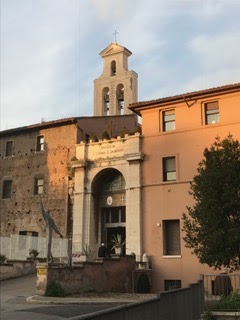
Saturday, March 18, 2017

Saturday of the 2nd week of Lent - Sts. Marcelinas and Peter

From PNAC.org

To visit the little church of Ss. Marcellinus and Peter, sitting at the corner of two busy Roman streets, is to encounter a long tradition of devotion at this site.  The saints after whom this church is named present a contrast in personalities, brought together in the service of the Gospel.  Peter was an exorcist who, because of his outspoken defense of the Faith during the Diocletian persecutions, was imprisoned.  There, the peace he exhibited despite his impending death attracted the interest of his jailer, with the martyr’s witness eventually bringing about the conversion of the jailer and his family.  Following this, many conversions followed, for which Peter sought the assistance of the priest Marcellinus to administer Baptism.  This priest, although of a quieter nature than the exorcist, nevertheless did not hesitate in coming out to celebrate the sacrament.  Although the persecution briefly waned after this, upon its renewal both Marcellinus and Peter were arrested and judged guilty.  After a few days of further rough treatment both were brought to a deserted place outside the city called the silva nigra, “black forest,” on account of its remote location.  There they were to be beheaded, where nobody would find their remains to venerate them.  However, after their martyrdom a bright light was seen to shine in the place, so that the area was now called the silva candida, “white forest.”  After appearing to two Christian women, the bodies of the saints were brought to the catacombs, where they lay for several centuries.  In the ninth century their relics were brought to Germany for use in new churches then being built there; they now rest in the city of Seligenstadt.

The first records of a church built in their honor are from the late sixth century, although it is possible that the church was built as early as the late fourth century by Pope Siricius (r. 384-399).  After being modified several times over the succeeding centuries, a decision was arrived at to rebuild this church in the mid-eighteenth century, and demolition of the ancient structure began in 1750.  The construction of the current church began soon thereafter, concluding in 1754.  The new church stands somewhat forward of the location of the one previous.  Since this rebuilding some minor cosmetic changes have taken place, but the overall appearance of the church remains the same.
While the church itself is pretty small, what it lacks in size it makes up for by the story of humanity found within its walls: little known martyrs and the life of a still active parish.  

Friday, March 17, 2017

Cape Town, South Africa


Just some photos from the past couple of days here in Cape Town.

Joe Quinn (the Lieutenant here) and Cardinal O'Brien

Me and Joe Quinn

Joe Quinn, Cardinal O'Brien and Dino Gomes (of the Order)

Thought about bringing this back to Rome for our balcony...

Canon demonstration at Castle of Good Hope

Castle of Good Hope - with city behind


"Key ceremony" at Castle of Good Hope

The Waterfront & Table Mountain.


Friday of the 2nd Week of Lent - San Vitale in Fovea


Today the PNAC.org site makes a neat connection between this church and St. John Fisher (from England)...
We begin our visit to this church not in Rome but in England, in one of the dungeon chambers of the Tower of London.  There, in 1535, sat the bishop of Rochester, imprisoned for his refusal to sign the oath which would affirm Henry VIII as the supreme head on earth of the church in England.  Pope Clement VII, hoping to save the faithful bishop, elevated him to the honor of cardinal and assigned him this church as his title.  Upon hearing of this, the king declared that, rather than send the red hat to England as was the custom at the time, he would send the bishop’s head to Rome.  And so did St. John Fisher bear witness with his life to the truth, as did the saints here commemorated.
The patron of this church, St. Vitalis, himself bore heroic witness with his life during the Roman persecutions.  There are several histories about his martyrdom, which seem to place the date of his suffering in the early second century.  He seems to have been of some social standing, and would encourage those about to die for the faith.  As a result, he himself was tortured on the rack and then killed in the area of Ravenna.  Traditionally he is believed to be the husband of St. Valeria and the father of Ss. Gervasius and Protasius, all of whom were also martyred.

This was originally the site of a small oratory built in the fourth century, dedicated to the martyrs Ss. Gervasius and Protasius.  At the end of that century a rich widow named Vestina left all her money to the shrine, enabling the construction of a much larger church with the same name.  This was dedicated by Pope Innocent I in the early fifth century.  He also created here the Titulus Vestinae in honor of the donor; this is last- built church to be include in the list of the original tituli of Rome.  Originally, the front of the church was open to the street, as was also the case in Ss. John & Paul and St. Peter in Chains.  However, soon after its dedication these arches were closed.  In the seventh century this church first began to be referred to as St. Vitalis, also being included in the stational list around the same time.  The church was renovated in the twelfth century, and again in the late fourteenth century.  It is interesting to note that, while the church is recorded as being in ruins before this latter renovation, it is still listed as having clergy assigned to it, leading us to wonder at the conditions in which they served here.  Pope Sixtus IV closed off the aisles in 1475, reducing the church to a single nave.  The current decoration was completed from the late sixteenth century through the eighteenth century, in the styles of those periods.  In 1859 Bl. Pius IX oversaw a restoration of the church, followed by another one almost a century later in which the original porch was revealed.

The church is entered by descending a LONG flight of steps (which you can see if the first photo), made necessary by the raising of the street level in the late 19th century.  The restored porch is supported by columns made for this church, an exception from the practice of the time in which it was more common for parts of older buildings to be recycled in new construction.  The 5 original archways can be seen at the back of the porch.  Your eyes are moved toward the high altar - where there are images depicting martyrdoms.  On one side, St. Vitalis being tortured on the rack, and on the right his martyrdom by being burned alive.  While this church may first seem as simply a gallery of suffering, it cannot be forgotten that this is not a suffering unto death, but unto the promised life without end - be it the suffering of St. Vitalis or St. John Fisher.